Wij maken gebruik van cookies om uw ervaring te verbeteren. Om te voldoen aan de nieuwe e-privacyrichtlijnen, vragen we uw toestemming om de cookies in te stellen. Meer weten.

Website

 SafeGear Danmark
 SafeGear International
 SafeGear Deutschland
 SafeGear Spain
 SafeGear France
 SafeGear Italia
 SafeGear Norge
 SafeGear Sverige
 Safegear Belgium
 Safegear Switzerland
 SafeGear Catalonia
 Safegear Czech Republic
 Safegear Latvia
 SafeGear Slovakia
 SafeGear Finland
Security Safes
Questions and answers about Safegear Safes
What Level of Burglary Protection is Right for You?
The amounts that can be insured in a specific safe variate across European countries. Safes have to be certified according to EN-1143-1 or EN 14450 regulations. These well-defined standards classify safes into security Grades.
Safe locks: All you need to know
Find below the most Frequently Asked Questions regarding security, battery and other concerns of Safe Locks.
Heb ik een wapenkluis nodig?
Volgens de Nederlandse wetgeving moeten wapens worden opgeslagen in een wapenkluis of een vergelijkbaar type kluis. Deze moet verankerd zijn in de muur of in de vloer, tenzij de kluis meer dan 200 kg weegt en dus niet gemakkelijk meegenomen kan worden.
Safes: What does Safe Burglary Grade or Rating mean?
Safes have to be certified according to EN-1143-1 or EN 14450 regulations. These well-defined standards classify safes into security Grades.The amounts that can be insured in a specific safe variate across European countries.
Safes: What are the European Norms for Burglary Safe Ratings?
The EU Norms for Burglary-resistance safe ratings are values given by independent institutions recognized throughout Europe. The burglary grade could play a role for the insurance category of the stored valuables.
Install a safe: All you need to know
Find below the Read More link the most Frequently Asked Questions related to bolting, placement and installation of a security safe.
Gun Safes: Will my guns be subject to humidity/rust if I leave them in my safe for a long time?
If you want to prevent your guns and ammunition from getting rusted, you should always protect them from humidity. Depending on what kind of safe you own and its location, moisture may develop inside the safe and can damage the content beyond repair.
Therefore, we recommend that you open the safe every 2 weeks for at least 15 minutes, to ensure that your documents/guns remain in the pristine condition in the safe.
Furthermore, you should always pay attention when choosing where you want to install the safe. It is always better to avoid places with high humidity levels, such as basements or any places close to laundry rooms.
It is also advisable to place a dehumidifier in the safe if it is placed in an area with high humidity.
Install a safe: How can I install a floor safe?
The floor safes a perfect solution for storing jewelry, documents, cash, and other valuables. One of their biggest advantages is the fact that floor safes are very difficult to find, especially if you place a piece of furniture on top. Floor safes are also ideal if you have limited space. It is very important that the safe is installed and secured in the correct way.
1. First of all, determine the desired location for installation. Make sure there are no wires, heating systems or pipes before starting your work.
2. Prepare the hole by digging in the floor. Don't forget that you need extra room around the safe.
3. Pour concrete mix in the hole and let it dry. For BT floor safes, it is recommended to pour 70mm of concrete mix. Do it carefully, this is an important step, and overfilling the hole would make your safe protrude out of the floor!
4. Then, pour gravel (or fine sand) over the bottom layer of concrete. For BT floor safes, 30 to 40 mm of gravel is recommended.
5. Insert the safe in the center of the hole with the top cover on.
6. Use concrete mix to fill in the space around the safe.
7. The top of safe must not exceed the ground level.
8. Smooth the surface of the concrete by a trowel.
9. Let the concrete set. Please keep in mind that if the installation is not done in the correct way, the safe loses its warranty.
This is the full floor safes installation manual for BT floor safes.
For more information, have a look on our floor safes and wall safes variety.
Chemical safe: What additional attributes do the chemical safety cabinets have?
A variety of chemical storage cabinets interior equipment is available, such as a bottom collection sump, drawers, and height-adjustable shelves. You can read more about the chemical safes accessories options under the products description.
A bottom collection sump is a piece of possible interior equipment for all of the chemical storage cabinets we offer. The collection of leakages is crucial for the safe storing of chemicals.
The Q-CLASSIC 30, Q-DISPLAY 30, Q-CLASSIC 90, Q-PEGASUS 90 and Q-PHOENIX 90 can be also delivered with metal-free interior equipment, height-adjustable shelves, and drawers with high storage volumes for small containers.
The UB 90 line interior equipment includes integrated drawers and second level drawer, which allows optimal utilization of inside space and it perfect for small containers.
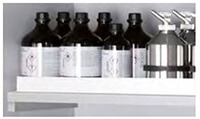 Metal-free interior equipment for storing aggressive hazardous materials
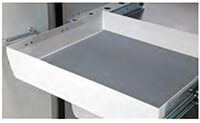 Metal-free interior equipment for storing aggressive hazardous materials
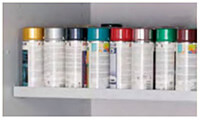 Height-adjustable shelves
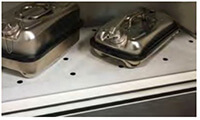 Bottom collecting sump for safe collection of leakages (for Q line)
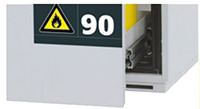 Integrated drawers
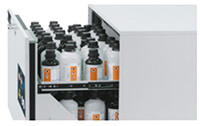 Second level drawer
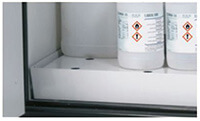 Bottom collecting sump for safe collection of leakages (for UB line)
Chemical safe: How should I store my chemicals?
Four important rules about the correct way of storing hazardous materials:
1. It is a good idea to create a list specifying the compatibility between the chemicals used in your laboratory/workplace as well as their general characteristics in order to assess their risk. Therefore, a label with the substance nature must be placed on the containers. It is very important to store the chemicals according to their compatibility, since they can be explosives, flammables, oxidizing, cryogenic and so on. Some of them must never be kept together.
2. Make sure you comply with the Work Health and Safety Regulation and chemical storage regulations.
3. Don't forget to use appropriate working clothes and equipment.
4. Chemicals must be stored in ventilated environments.
The chemical safes offered on our website are innovative solutions for the professional storage and handling of dangerous substances. They are certified with 30 to 120 minutes fire resistance and possess an advanced ventilation system, which makes them a good combination of safety and quality.
Install a safe: How can I install a wall safe?
Before installing a wall safe, you need to determine the right location because you will need to make a hole in it. Consider next points:
- The wall opening must be big enough to surround the safe on all sides with at least 10 mm of concrete.
- Position the safe inside the hole with the sign 'Top' above, make sure the safe is not upside down. Moreover, the vault must be aligned and well wedged.
- Prepare the right concrete mix and tamping for filling the wall opening, which includes 3 parts gravel (0-32 mm in size), 1 part cement and just enough water to get the right consistency.
- Protect your safe from the concrete using a plastic foil.
Prepare a formwork to mark your wall opening before pouring the concrete. Fill in the wall opening and spread well using a concrete rake. - After you have installed the safe, wait for 48 hours before removing the formwork. Then, you can open the safe for airing


 Need more information about the right consistency of concrete? Read our Installation Manual for Wall Safes WEGA series.
Need more information about the installation? Read our Installation Manual for Wall Safes VC series.
 Check the series we can offer you under category Safes> Floor Safes / Wall Safes
Install a safe: Where should the safe be placed?
The best place to place a safe depends on where you can bolt it. A safe needs to be bolted to concrete or cement to guarantee it cannot be moved.
A safety box may need an accessible location as you need to access on a frequent basis.
A wall safe or a floor safe can be an interesting option to choose a hidden yet easily accessible spot. In case you cannot place it on hidden location consider choosing the highest level of burglary rate.
Use the burglary grade filter to search at: Safes>Valuable Safes
Check our floor and wall safes at: Safes>Floor Safes / Wall Safes
Install a safe: Where can I bolt the safe?
A safe can be bolted to:
- The floor
- The wall
- Inside a wardrobe
Pay attention to the material of the surface you want to bolt your safe in.
- Concrete offers a safer and more solid way of bolting than wood.
- Depending on whether it is a wooden or concrete floor, you will need a different drill and a different drill bit.
- Check if there is underfloor heating, cables or wires in the wall/floor you want to drill into.
- When bolting a safe in a wardrobe consider if it has a wooden back, we strongly recommend that there is no excess space between the safe and the back wall. The best way to ensure that the safe has direct contact with the back wall is to cut a hole corresponding to the size of the safe.
Install a safe: Why is bolting important?
Bolting prevents the safe from being moved by burglars, provides stability to your safety deposit box and most insurance providers stipulate some kind of reference to a correct installation.
We recommend you either bolt to the wall, anchor down to the floor, or both. Even the heaviest safes must be bolted for extra security.
Safe Check the terms and conditions of your insurance contract to comply with requirements.
Pagina
- U bekijkt nu pagina 1
- Pagina 2
- Pagina 3
- Pagina Volgende
