Wij maken gebruik van cookies om uw ervaring te verbeteren. Om te voldoen aan de nieuwe e-privacyrichtlijnen, vragen we uw toestemming om de cookies in te stellen. Meer weten.

Website

 SafeGear Danmark
 SafeGear International
 SafeGear Deutschland
 SafeGear Spain
 SafeGear France
 SafeGear Italia
 SafeGear Norge
 SafeGear Sverige
 Safegear Belgium
 Safegear Switzerland
 SafeGear Catalonia
 Safegear Czech Republic
 Safegear Latvia
 SafeGear Slovakia
 SafeGear Finland
Security Safes
Questions and answers about Safegear Safes
Chemical safe: What additional attributes do the chemical safety cabinets have?
A variety of chemical storage cabinets interior equipment is available, such as a bottom collection sump, drawers, and height-adjustable shelves. You can read more about the chemical safes accessories options under the products description.
A bottom collection sump is a piece of possible interior equipment for all of the chemical storage cabinets we offer. The collection of leakages is crucial for the safe storing of chemicals.
The Q-CLASSIC 30, Q-DISPLAY 30, Q-CLASSIC 90, Q-PEGASUS 90 and Q-PHOENIX 90 can be also delivered with metal-free interior equipment, height-adjustable shelves, and drawers with high storage volumes for small containers.
The UB 90 line interior equipment includes integrated drawers and second level drawer, which allows optimal utilization of inside space and it perfect for small containers.
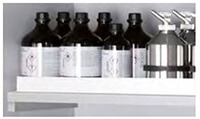 Metal-free interior equipment for storing aggressive hazardous materials
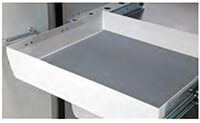 Metal-free interior equipment for storing aggressive hazardous materials
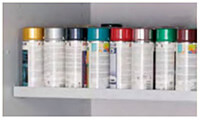 Height-adjustable shelves
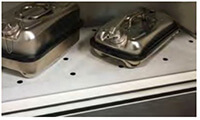 Bottom collecting sump for safe collection of leakages (for Q line)
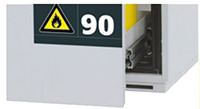 Integrated drawers
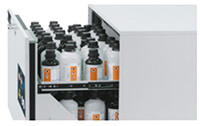 Second level drawer
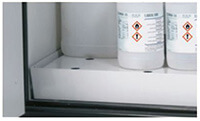 Bottom collecting sump for safe collection of leakages (for UB line)
Install a safe: Can you help me with the installation of my safe?
Yes! SafeGear is very happy to offer support in your delivery & installation process of one of our certified safes. Safety and security during the implementation plays a vital role for us. Therefore, we decided to cooperate with professional safe engineers who are able to secure and guarantee this.
The costs regarding this depend on numerous factors:
- the exact weight of the safe
- the bolting process (if you wish it to be bolted on the wall, floor or somewhere else)
- the floor you live on
- general accessibility of your apartment/house
- existing elevators or stairs
Planning your delivery and installation process with our support saves you a lot of time, avoids wrong installation and prevents any damage.
A frequent error when installing a safe without professional help is that many people leave a space between the safe and for example the wall, without bolting it appropriately. Moreover, if stored in a wardrobe, it should not be solely put inside, one should create a possibility to bolt the safe to a solid ground. Not following those procedures decreases security and simplifies theft. Our engineer specialists with experience in the vault industry can perfectly install your safe in the wished location and therefore facilitate your life and secure your valuables.
If you consider delivery & installation with our help, please inform us beforehand so we can prepare and arrange the best fit for you.
Install a safe: What should I consider when bolting my safe?
Consider next point when:
- The material of the wall/the floor plays an important role here. For example, concrete ensures a safer and more solid bolting material than wood.
- Make sure you check if there are any cables or wires in the wall or the floor you want to drill into. Be careful with the heating and/or piping system as well. If you have underfloor heating, we strongly recommend that you do not drill down into your floor. Instead, you can secure your safe by bolting it to the wall.
- If you don't have a solid floor surface, consider a wall safe installation.
- You might need the help of a second person to move the safe into position.
- We advise bolting the vault both to the wall and floor if possible.
Install a safe: What do I need to install my safe?
You only need a quality drill and the corresponding drill bit (usually 10-12 mm diameter).
If the safe is prepared for installation, it will include pre-drilled holes, therefore you can install the safe yourself.
You can check in the details section on each product page if the safe includes anchor bolts.
The only thing you will need then is a drill and the corresponding drill bit (usually 10-12 mm diameter).
Please keep in mind that the length of the bolt is usually 20cm, so you need to know the thickness material of the floor. You should also consider if there is any wiring or piping in the installation location.
If there are any wiring or piping systems in the installation location, we would recommend you to bolt the safe to the wall instead.
Install a safe: How can I bolt the safe myself?
Be aware that there are no wiring or piping in the location you want to install the safe.
Follow these steps to bolt your safe:
You can easily bolt your safe following 8 simple steps.
|
|
1. Place the safe onto its final position. |
 |
2. Mark the spot on the floor or the wall where the bolting holes are located. |
 |
3. Move the safe aside. |
 |
4. Make sure you use the right drill for the material and an appropriately sized drill bit. |
 |
5. Drill holes into the designated marks. |
 |
6. Reposition the safe over the mounting hole. |
 |
7. Insert the bolt through the inside of the safe into the hole. |
 |
8. Tighten up the nut of the bolt. |

Install a safe: We have underfloor heating. Can we still bolt our safe to the floor?
If you have underfloor heating, we strongly recommend that you do not drill down into your floor.
Instead, look for other ways to secure your safe:
1) Bolt your safe to the wall instead of the floor.
2) Buy a heavy safe that is difficult for a thief to remove. Safegear has safes weighing hundreds of pounds that are specifically built for this purpose.
Obviously, you can combine the two options where you buy a heavy safe and bolt it to the wall for extra protection.
Fireproof Safes: What Makes a Safe Fire Resistant?
Fire resistance means that the safes resist heat and smoke (and some protect against water) over a given period of time.
Fire resistance is created by the use of certain materials inside the walls of the safe. The walls are filled with a special concrete and water mix. The relatively high amount of bound water in the mixture prevents the safe from heating up too fast. The walls and the door not only include special materials but also are thicker than security safes that are not fireproof.
Common fire resistance levels:
 Fire insulation layer -not certified- that protects from initial phases of a fire.
 Internal temp. under 170ºC for 30 min with external temp. above 842ºC
 Internal temp. under 170ºC for 60 min with external temp. above 842ºC
 Internal temp. under 180ºC for 90 min with external temp. above 1006ºC
 Internal temp. under 170ºC for 120 min with external temp. above 1090ºC
Fireproof Safes: Does the fire insulation lose its effectiveness after time?
No. As long as the safe does not suffer any damages, the fire insulation will be just as effective as when you bought the safe.
Fireproof Safes: Will a fireproof safe protect paper and also a hard drive?
Before buying a fireproof safe, you need to consider that the sensitivity to heat varies throughout material. So you should know the material of the valuables you want to keep protected from fire damage. Usually, it is distinguished between documents (business reports, licenses, birth certificates, old artifacts, passports, insurance documents etc.) made of paper, and data (hard drives, CDs & DVDs, old negatives & photographs, flash drives, old cassette tapes, USB drives, micro SD cards, etc.). Thus, different fire resistance standards are required:
Fireproof Safes for Paper Documents
When exposed to fire, the interior temperature in the closed safe should not increase by more than 150°C because this would harm the documents. As an insulation material, a special mixture of cement/mortar and water is usually used. The relatively high amount of bound water in the mixture keeps the temperature in the wall of the safe at a maximum of around 100°C.
Fireproof Data Safes
Data is damaged at lower degrees. So when exposed to fire, the interior temperature in the closed data safe should not increase by more than 30-50°C. The walls of the safe are usually constructed in several layers. In the first layer, a special mixture of cement/mortar and water is used. There the temperature does not increase to more than 100°C. In the middle layer, special insulation materials are used, which prevent the heat from getting through the wall. As third layer, heat-absorbing material is used, which has a cooling effect on the wall.
Depending on the requirements of the fire resistance class, different filling materials or wall thicknesses are used.
Common to both types: Sealings are installed in the gaps of the door. Depending on the fire class requirements, high-temperature-resistant seals against fire gases or penetrating heat are utilized. These modern seals swell from a certain temperature and reliably close the door gap in the event of a fire.
Fireproof Safes: All You Need to Know
Fireproof or fire-resistant means that the safes resist heat and smoke (and some protect also against water) over a given period of time. Before buying a fireproof safe you should consider some points. Click Read More to get to know the details.
Which type of plug do I need in my Computer Safe?
The most common charger for computers and electrical devices in Europe is the schuko plug, that has two round sticks for charging (230v 16A). This is the standard for most SafeGear safes. In countries like Denmark however, the earthing has an extra stick in the socket. Please conslut SafeGear if you need a different socket for your safe.
Hotel safe: Is it possible for the hotel to access information on when the safe was opened or closed?
Most hotel safes come with an audit feature that enables the hotel to view a log of the last 100 locking processes. This log is accessible only to hotel managers or administrators through the used of a master code or master key. in order to prevent unathorized use.
Hotel safe: I am considering buying a hotel safe. What anti-burglary certification do hotel safes come with?
Hotel safes generally do not come with certifications as the use they will be put through, most often will not require this added certification. However, the protection they offer is always welcomed by guests. Hotel safes are more than adequate for the great majority of guests. Users can safely store valuables in the safe in their rooms and forget about this risk of burglary when left unattended. In the case of higher profile clients requiring improved protection, we invite you to check out the other safes with added features that are part of our selection.
I'm having some technical issues with the safe. Can I send a video?
In case you are having a problem with your safe you should make a video. This way, we will be able to understand what is going on and provide our best solutions to help you.
Pagina
- Pagina Vorige
- Pagina 1
- U bekijkt nu pagina 2
- Pagina 3
- Pagina Volgende
